Warning: Spoilers and spoiler images abound below!
The visual effects in Keeper will destroy your concept of reality, but according to visual effects supervisor Ed Douglas, the goal was never spectacle. The goal was disorientation and tragedy.
Douglas’ collaboration with writer-director Osgood Perkins has now encompassed Longlegs, The Monkey, Keeper, and the upcomingThe Young People, an ongoing partnership that fundamentally shaped how the VFX function in Keeper. “It’s a shorthand, not only with Oz, but with the department heads, the producers, the artists, and the craftspeople,” Douglas says. “When you’re working with the same props team… the same production designer, the same camera crew, there’s such a shorthand between everybody.”
That shorthand matters because Keeper was made under uniquely constrained circumstances. Shot during the industry strikes as a lean, Canadian production, the film was intentionally small and intimate. In it, couple Liz (Tatiana Maslany) and Malcolm (Rossif Sutherland) head to his cabin in the woods for a little getaway and…well, things go awry, honey.
Douglas wasn’t even on set for most of it, dialing in via FaceTime while the movie took shape. “It was so lean,” he said. “I was definitely part of the family, but I wasn’t part of the day-to-day production.”
Those limitations became an unexpected advantage. Anchored by Tatiana Maslany’s performance and a house that deliberately disorients both audience and crew, the film’s visual language demanded subtlety rather than excess. Perkins pointed Douglas and cinematographer Jeremy Cox toward Robert Altman as a reference point. “It was the observational perspective that Altman brings,” Douglas explained. “Always seeing past layers through windows, past foreground… slow zooms in a space where you lose all sense of geography.”
That loss of geography wasn’t theoretical. “That house was a place where I lost sense of geography,” Douglas said. “I was trying to figure out, ‘Where am I in this house?’” Even the VFX team struggled to reconstruct it digitally. “The 3D artists trying to put that back together, that was a mind-bending head scratcher.”
The film’s most striking VFX sequence comes in the final moments, with the reveal of the creatures that have lurked in the background. “A version of everything was in the cut without any visual effects at all,” Douglas said. Only after Longlegs and The Monkey found success did the team realize they had room to push Keeper further. “We knew there was a chance to expand on that… but we didn’t want it to feel like a big… Marvel computer fest.”
Instead, Douglas and Perkins turned to folk horror and unexpected references. “What would a folk horror live-action Studio Ghibli creature be?” Douglas asked. The guiding principle became something “horrifying in the moment, but has a tragic beauty to it as well.”
The creatures—referred to internally as “witchlings”—were built from philosophy first, visuals second. “It comes from a philosophical idea first,” Douglas said. “She’s a representation of everything that’s come before her.” Each creature incorporates scanned faces of the previous victims in the film, transformed into effigy-like masks. “If you look close, you can recognize them,” he said. “To us, that was really important.”
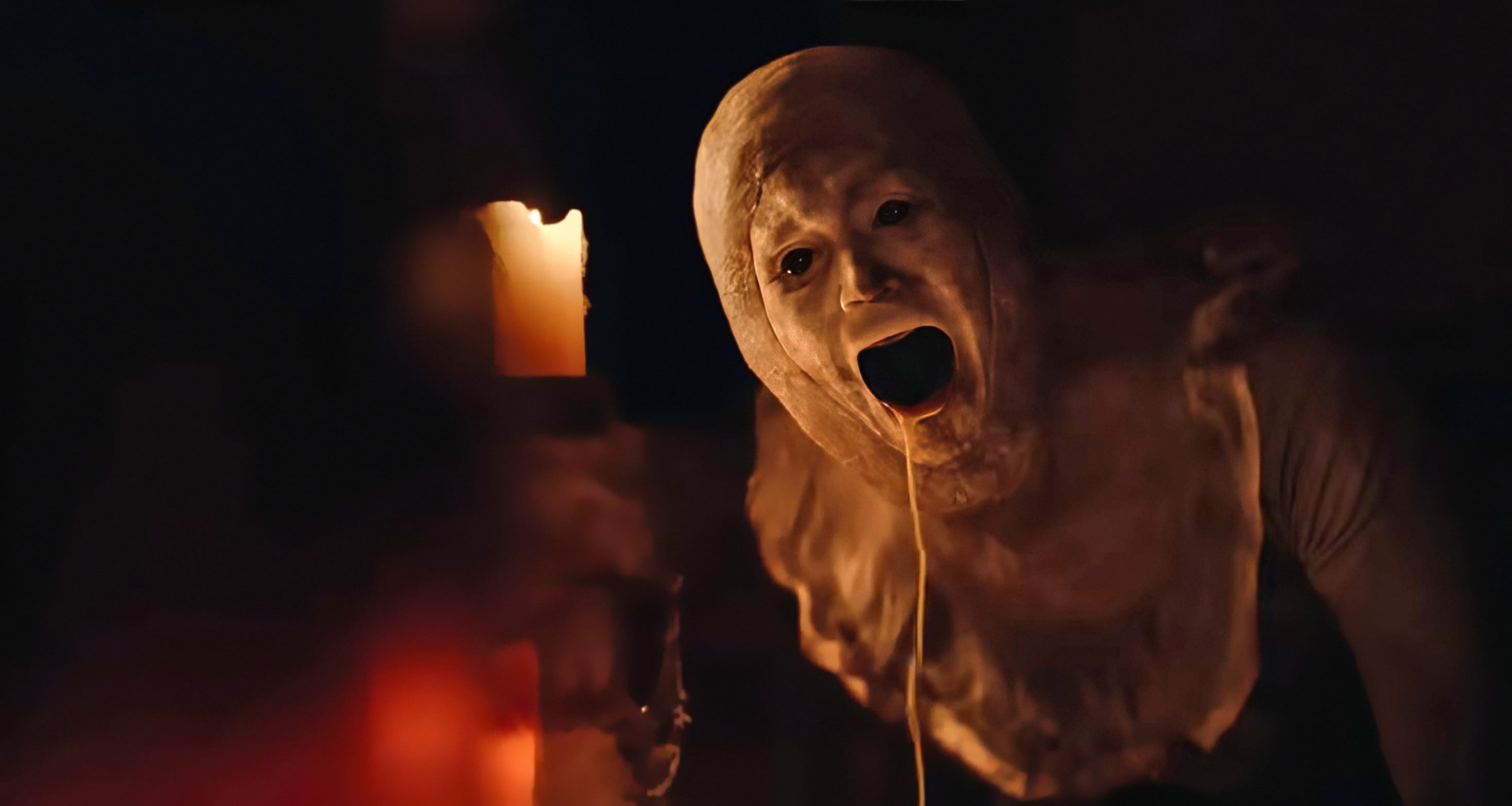
Even the most grotesque details were grounded in practicality. One creature’s constant vomiting was directly tied to an earlier live-action scene. “I called up the makeup artist who had her movie barf mixture—which was creamy mushroom soup and chicken stock—and said, ‘Simulate that,’” Douglas said. “We never had to have a meeting about it.”
That commitment to grounding extended to the most technically complex work: Maslany’s multi-faced transformation. “She was the base face,” Douglas said. “Her eyes, her nose, her mouth: We knew we had to keep that pure.” Everything else was painstakingly tracked onto her performance by Image Engine in Vancouver, a studio better known for massive franchise work. “They had such joy in working on our weird little indie movie,” Douglas said.
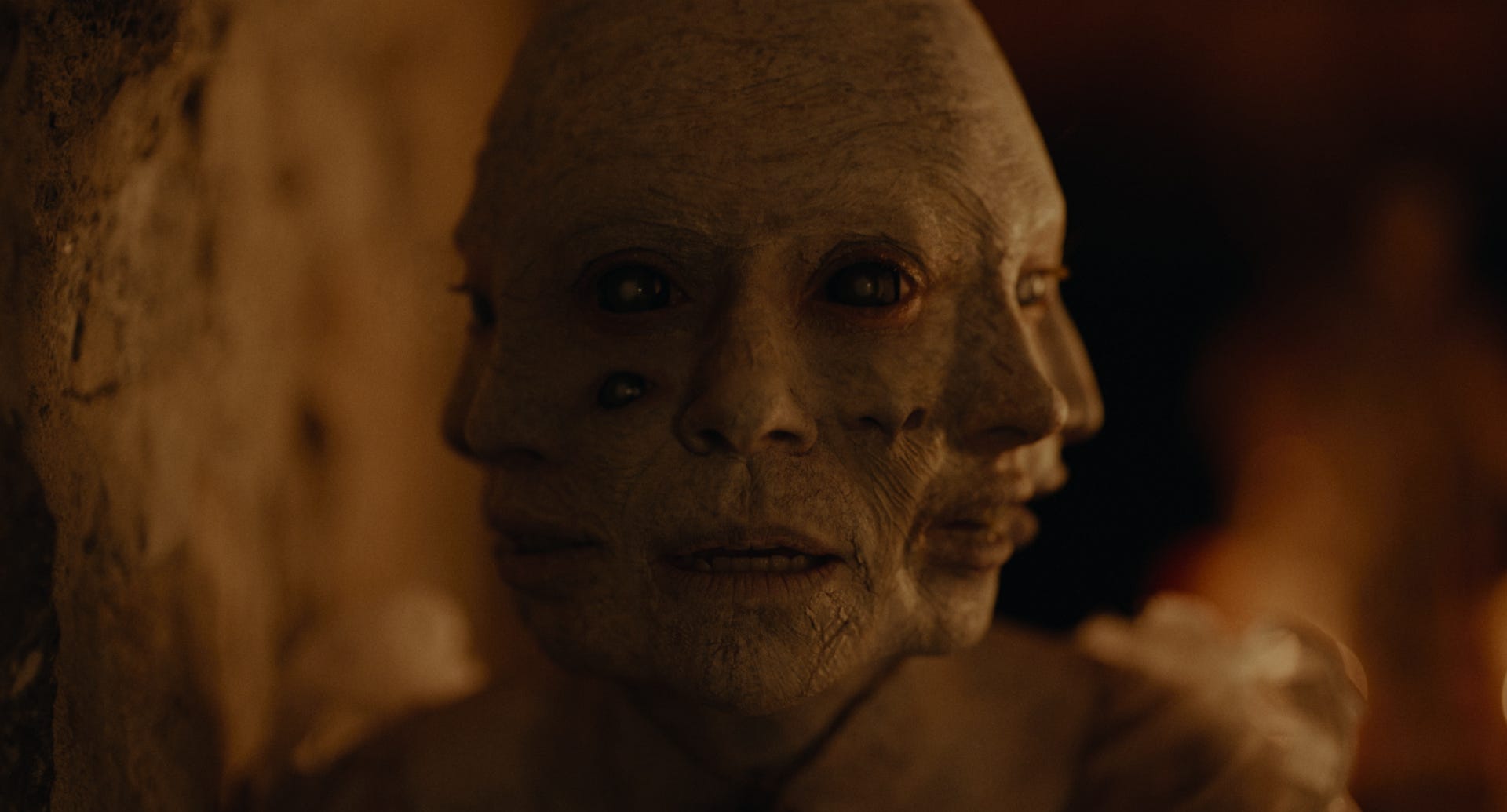
The effect is so seamless that many viewers assumed it was prosthetic. “That’s the highest compliment I could ever get,” Douglas said. For him, the success of the sequence was confirmed when editor Graham Fortin recoiled on first viewing. “He said, ‘I can’t look at this. It bothers me so much. I don’t know where to look. It hurts my brain.’ And that was an incredible reaction.”
For Douglas, that reaction signaled that the team had achieved something rare: visual effects that unsettle not through shock, but through perception itself. “It’s beautiful,” he said. “It’s gorgeous.” The horror comesnot just from what you’re seeing, but in your inability to understand how you’re seeing it.
That approach reflects Perkins’ broader creative philosophy. “‘Find the right people, you point them in the right direction, and you get out of their way,’” Douglas said. “He inspires… and he’ll curate what comes back and nudge you in the right direction.”
Three movies deep and counting, that seems to be the right approach.
Edward Douglas is a VFX supervisor whose credits include Longlegs, The Monkey, and Fuze. His go-to at craft services?” We’ve got these little containers of charcuterie, and when I’m trying to stay moderately healthy, staying away from all the sweet treats, that’s it. A bit more protein, but it’s such a little treat.”
 Meet Me at Crafty
Leave a comment