When production designer Brandon Tonner-Connolly signed on to FX’s The Lowdown, he already knew the first and most important truth of the job: this show could only be made in Tulsa. Not because of tax incentives but because creator Sterlin Harjo insisted—just as he insisted on the same for Reservation Dogs. “If he wasn’t so insistent on here in Tulsa, it definitely would’ve been the sort of thing where the network or just producers in general would’ve said, ‘Oh, this sounds like a perfect opportunity to shoot Albuquerque as Tulsa,’ or any other tax credit state like that,” Tonner-Connolly says.
But Harjo wasn’t budging, and that meant Tonner-Connolly wasn’t either. In fact, he brought with him several years of scouting Oklahoma’s back roads and side streets, thanks to Reservation Dogs. Before The Lowdown’s first season, the production flew him out for prep that wasn’t quite ready to begin. So he did what any production designer with time to kill in Tulsa would do: He drove, revisiting every weird little industrial building and forgotten storefront he’d clocked during Rez Dogs. “We said, let’s go look at all those places now,” he says. “Let’s have them in our back pocket.”
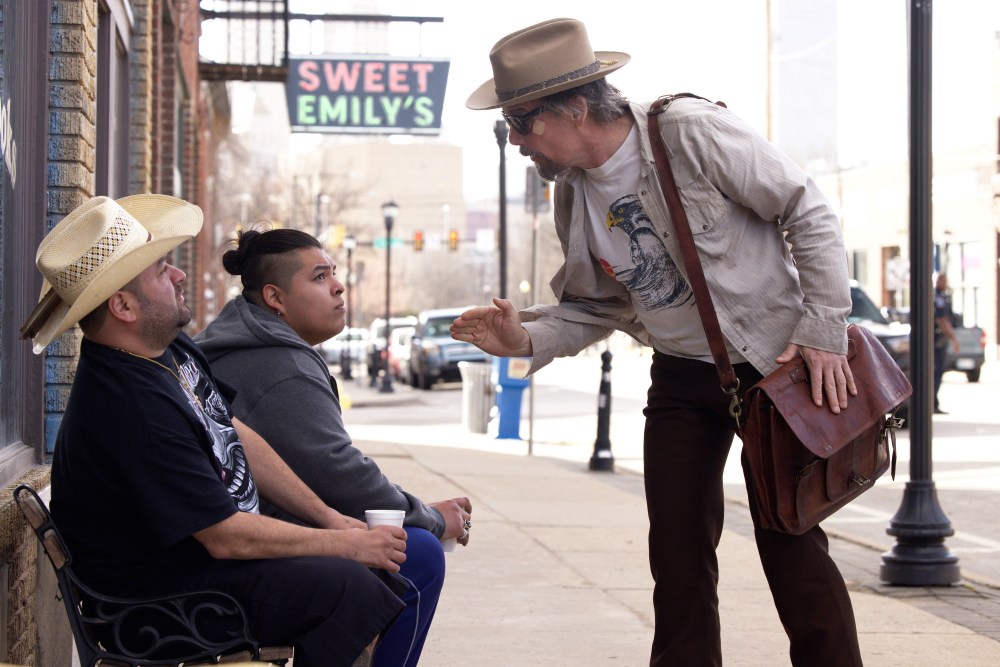
That instinct—to let the place lead—shapes every frame of The Lowdown. It’s why the show’s locations feel both heightened and handmade. It’s why the bookstore, run by Ethan Hawke’s character, looks like a place you could actually wander into, get lost in, and eventually forget whether you’re still on set or at an estate sale. “Every book in there had to make sense,” he says. “It all had to feel like something the character would have in his store.”
How effective was he? “More than once, I did see Sterlin and Ethan walking out of the store with a book that they had not asked about,” he says, laughing, “Shoplifting, if you will.”

To build the bookstore, he and set decorator Tafv Sampson meticulously assembled a collection of roughly 5,000 books, a book lover’s dream. “We were testing the limits of how much we could pay for a first edition,” he says. “I might have used the ‘Sterlin asked for it’ card a few times.”
But the real muse was Leroy Chapman, a friend of Harjo’s and an amateur journalist who loosely inspired Hawke’s character. Chapman’s real-life reporting—on Tulsa’s tangled, brutal, overlooked histories—became the backbone of the bookstore and the vast conspiracy “murder board.” Tonner-Connolly dove headfirst into Chapman’s work, building the collage not as a prop but as a logic map of a man thinking himself toward the truth. Here an article about a Confederate-connected Tulsa patriarch; there another about land theft; another about white supremacist compounds; another about the Oklahoma City bombing. “I presented it to everyone in a 20-minute walkthrough,” he says. “They were very happy with it, but they were also clearly concerned about my mental state.”
And he refused, with the passion of a man who has been online once or twice, to use red string for the murder board. “It would make us look like a meme!” he says. “I held that position down, and people came over to my side eventually.” Not all heroes wear capes.

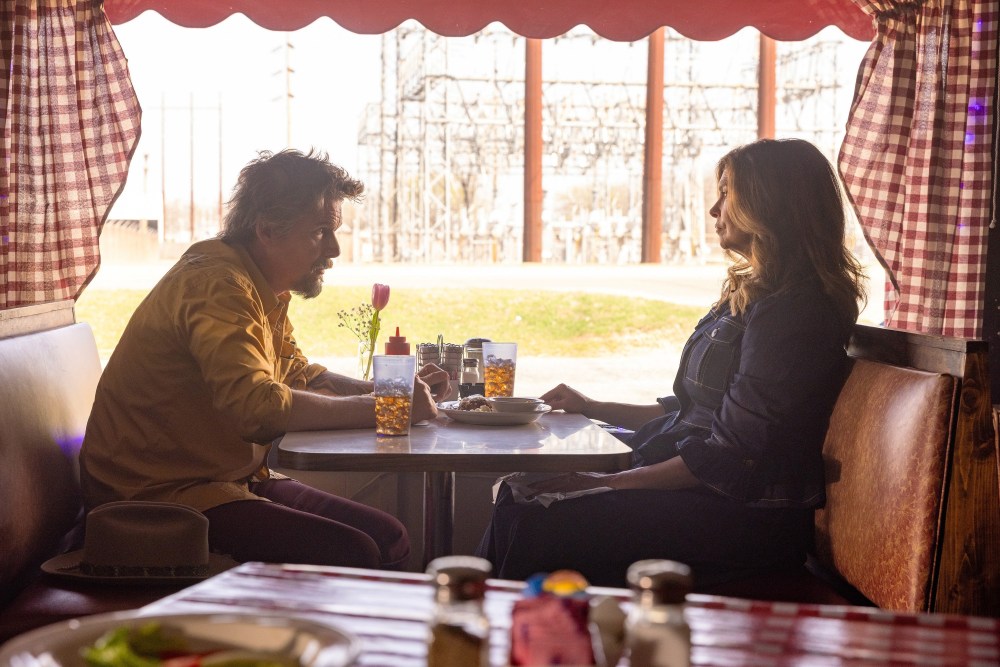
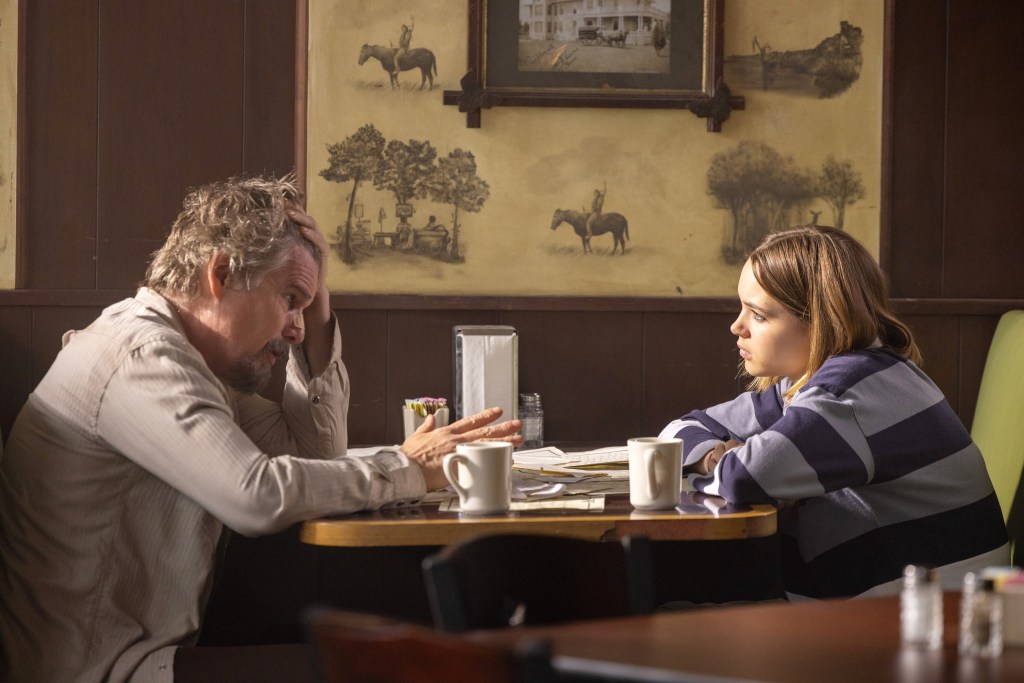
Elsewhere in The Lowdown, Tonner-Connolly finally gets to do something most production designers dream about and rarely get: build a perfect, deeply lived-in greasy spoon diner. Indoor low-pile carpet was non-negotiable (“Every Tulsa diner has it”), as were years of patina, stains, scuffs, and the invisible geometry of where waitresses tuck pens or how a cook might lean his weight after 20 years behind the grill. But the bespoke wallpaper featured illustrated scenes from Reservation Dogs, hidden in plain sight, and might be the show’s most quietly moving touch.
“We wanted something that felt like it could entertain you if you happen to be sitting there at 2 a.m. having a coffee and a cigarette by yourself,” he says. “But also, it didn’t draw your eye too closely. So we had the idea of some pastoral scenes and at some point, we jokingly said it could be scenes from Reservation Dogs.”
That was it; the team hired Mary Hayes to hand-illustrate some of their favorite moments and turned that into the wallpaper you see onscreen.
Then there’s the ephemera: the scribbled phone numbers by the landline, the taped-up dollar bills, the photographs of crew members’ grandparents. Tonner-Connolly even snuck in his own grandfather behind the counter. “It’s those small details,” he says. “You get the rhythms of life in the space.”
You can’t fake Tulsa. You can’t fake a bookstore built by readers. You can’t fake a murder board built by a historian. And you certainly can’t fake a production designer who shops for first editions like he’s getting away with something. The Lowdown doesn’t try to recreate reality—it creates one just left of center and all the more fascinating for it.
Brandon Tonner-Connolly is an ADG Award-winning production designer whose credits include I Saw the TV Glow, Briarpatch, and The Big Sick. His go-to at craft services? “I’ve been waiting for somebody to ask me this question my whole life,” he says with palpable glee. “For me personally, I love sugar. I don’t really drink coffee or anything like that, so I make up for it with sugar. And for me, the more synthetic, the better. So I’m into the Hostess cupcakes, I’m into the different Little Debbie products. I’m into the stuff that seems like a scientist made it in a lab and was trying to calibrate a flavor.”
 Meet Me at Crafty
Leave a comment