Welcome to the wild and wonderful era of Emmy Awards: Phase 1, a time before nomination voting when the arbitrary rules governing what is timely are set aside, and we can discuss projects that were released weeks or months earlier and deserve to be top of mind again. Wolf Hall: The Mirror and the Light premiered on PBS March 23, 2025.
One doesn’t return to a project a decade later if the initial production wasn’t a pleasure. And over and over again, the team behind Wolf Hall: The Mirror and the Light makes it clear that they loved every moment of both seasons.
“It’s one of those projects, they don’t come along often enough, where every second of screen time is relished by the entire crew,” costume designer Joanna Eatwell says. “That has to come from the top, from the director who gives everybody the gift of giving, if that makes sense. Peter [Kosminsky] has time for everyone. He’s extraordinary. He finds time every single morning to come to the costume truck, talk through the call sheet with me. He’s not checking up. He’s saying, ‘What gifts are you giving me today?’”
That kind of environment is a gift, and one that allows Eatwell to turn in some breathtaking work for the continued tale of Thomas Cromwell’s (Mark Rylance) rise and fall in the court of King Henry VIII (Damian Lewis). And it must be said that even over Zoom, Eatwell’s enthusiasm and fondness for her work shine through. Who wouldn’t eagerly return 10 years later to collaborate with her? (And that’s not even taking into account the cool factor of her early career, doing costumes for music videos for everybody from Elton John to Diana Ross.)
“It mustn’t be forgotten that we all came back to this project 10 years wiser and with a certain amount of knowledge,” Eatwell says. “And I think we all benefited from that. Yes, it’s daunting. [But] the actors in this project understand and enjoy costumes. They understand all the minutiae that we try to convey through costume. It’s there to inform the audience who these people are and the time in which they existed.”
That is both complicated and simplified within the context of Henry VIII’s court, thanks to Sumptuary Law.
“That tells us, [based on] your status and position, what colors you can wear, what furs you can wear, what fabrics you can wear,” Eatwell explains. “So we have a sort of roadmap of what we can use. We had such a strict hierarchy of a class system at this time that I need to know immediately whether you are my superior or my inferior, do I doff my cap to you, or do you doff to me? And this is such an important part of our story.”
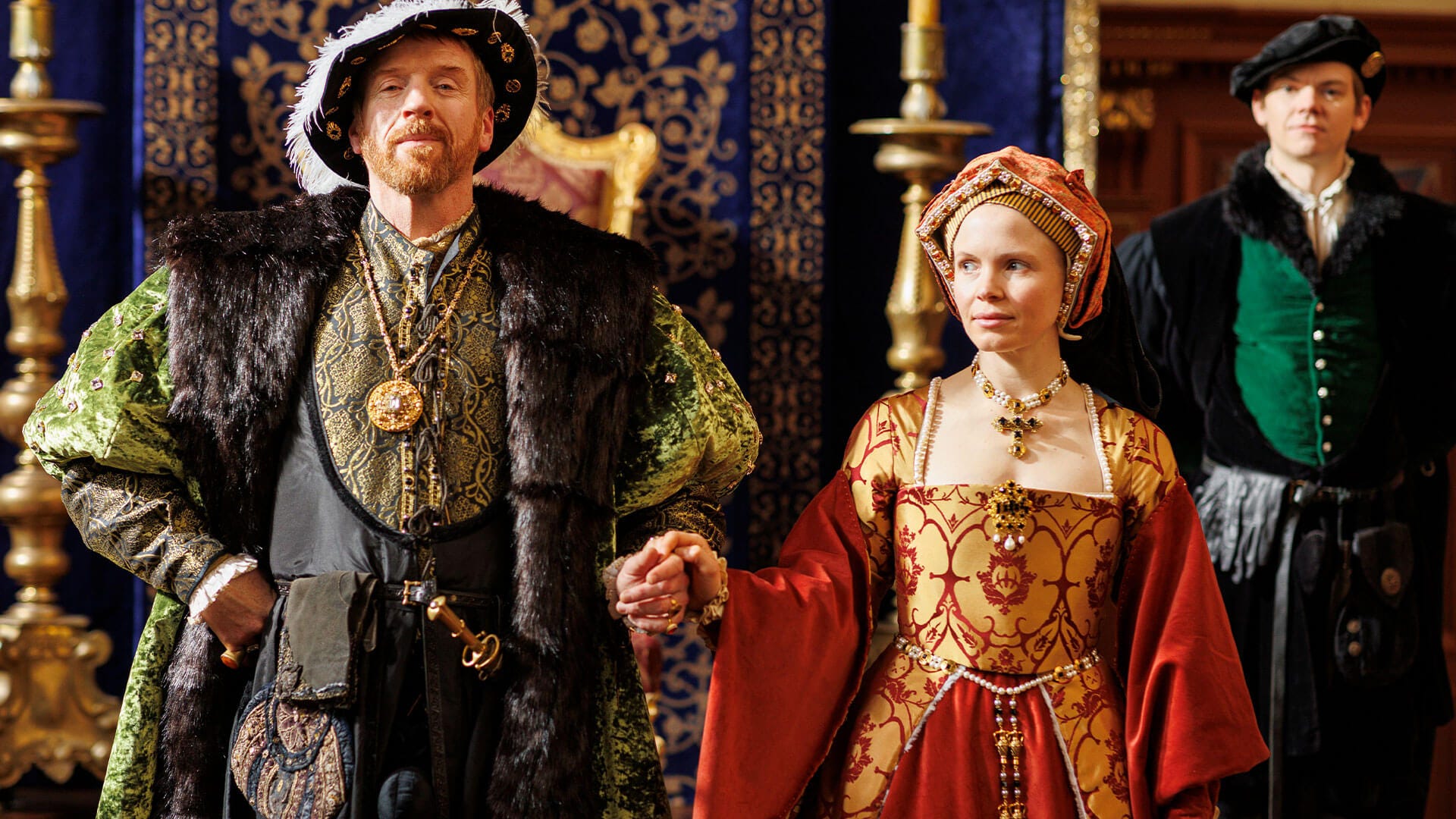
Adding to that realism is Eatwell’s use of “ original practice,” which entails designing and constructing costumes as closely and practically (within established schedules and budgets) as they would have been at the time. “The first thing you’ve got to do is work out what are the underpinnings,” Eatwell says. “Because if you don’t get the underpinnings correct, whether that’s corsetry padding, petticoat shifts, whatever, doesn’t matter how beautiful your outer gown is, it’s never going to look right if you haven’t understood how to create that silhouette. The other thing, of course, is the fabric weight, and that really is one of the biggest challenges. Often, we look to the Church because the Church is one of the few places that still manufactures these sumptuous fabrics. It’s one of the very few places you can get these silks and these heavy fabrics nowadays.”
Not that Eatwell knows of a secret fabric store in the Vatican (“I wish I could just go there,” she says, laughing), but there are a few places in England that still manufacture what she needed. Including one very specific request.
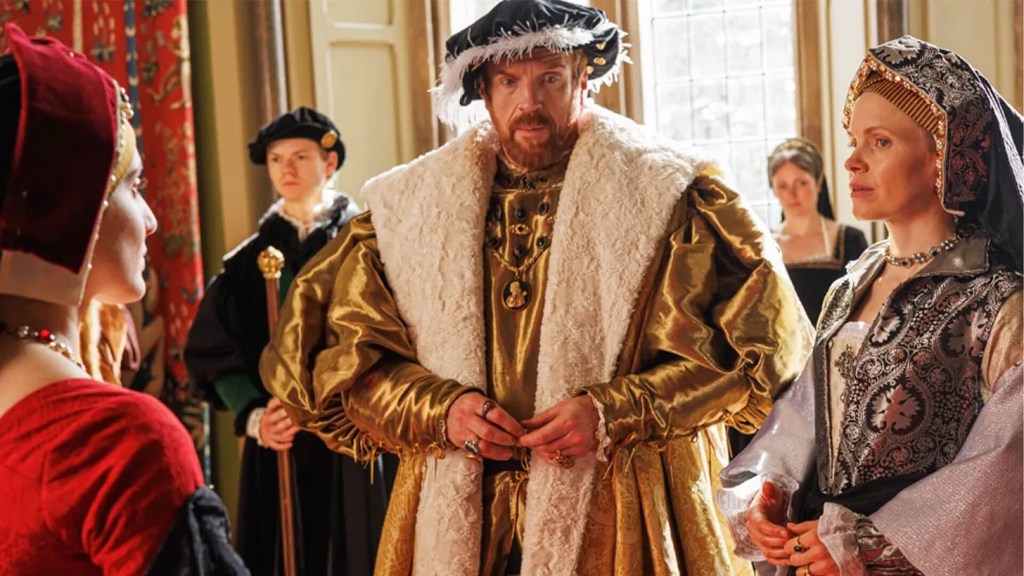
“In this show, we’ve used real cloth of gold because it gives you a certain [reflection] when it’s lit properly,” she says. “But what I find so interesting is [clothes of the era] aren’t sewn together. They’re not complete garments. Everything is pinned together or tied together. They’re really logical and practical, how they’re made. It means also if something’s damaged, you can replace it quite easily. You untie it or unpin it, and you can mix and match as well. They’re really wonderfully logical, the Tudors.”
That allows for yet more class distinctions, as well. In The Mirror and the Light, we see Henry being dressed by his servants (“ We are making that inverse triangle with the huge puff sleeves and the layers. You build the man, as it were”) and Cromwell dressing himself, with garments that tie together in the front. The difference is that of class. One needs servants; the other doesn’t.
Eatwell also points out that Lewis enjoyed Henry’s costumes (even as he becomes increasingly incapacitated over the course of The Mirror and the Light). “ He, like most male actors, really enjoyed putting on the costumes because they are essentially so masculine,” Eatwell says. “They give you wonderful broad shoulders, big chest, and narrow little hips, and beautiful, finely turned calves. Men look like peacocks. They look so beautiful in these clothes.”
Eatwell also relished the opportunity to dig deep into the period’s restrictions and requirements, something she points out doesn’t happen nearly often enough. “ It’s a very joyful project, but very hard work, I’m not gonna lie,” she says. “But I think everybody bought something to the piece and enjoyed it. We don’t very often get a chance to indulge that kind of depth or make heavyweight drama like this very often.”
Joanna Eatwell is a two-time Emmy Award nominee and CDG Award nominee. Her credits include Wolf Hall, Carnival Row, and A Spy Among Friends. Her go-to at craft services? “I’ve been a vegan for over 50 years, so I’m now just delighted that craft services do something that’s vegan, because back in those days of Diana Ross, nobody even knew what a vegan was. I’m just delighted when there’s something I can eat, to be honest.”
 Meet Me at Crafty
Leave a comment