Welcome to the wild and wonderful era of Emmy Awards: Phase 1, a time before nomination voting when the arbitrary rules governing what is timely are set aside, and we can discuss projects that were released weeks or months earlier and deserve to be top of mind again. St. Denis Medical premiered on NBC November 12, 2024.
Somewhere in downtown Los Angeles lies an abandoned replica of the St. Denis Medical set. Well, this one isn’t a replica; the NBC comedy shot its pilot in DTLA’s unused St. Vincent Hospital and then recreated it on the studio lot for the series.
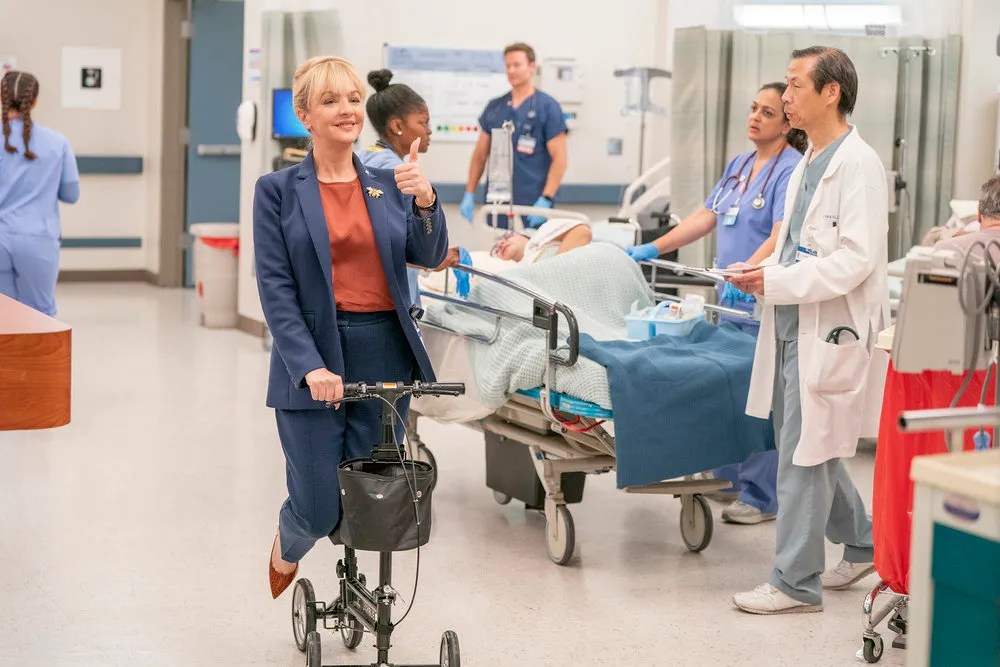
“A lot of thought went into finding a great location for the pilot—something that not only served the episode, but set the tone for the series as a whole. We looked at every feasible option,” production designer Elliot LaPlante said. “We narrowed in on a floor at St. Vincent Hospital with two distinct zones. One side with private patient rooms, where we layered in rich wood tones, and the other with curtained-off patient bays, where we focused on keeping things brighter and more frenetic.”
Having already chosen a color palette that indicated some time has passed since the last remodel, the team painted St. Vincent in its signature blues and greens and filmed the pilot, then moved to the lot and repeated what worked and reimagined what didn’t. “We really focused on creating the most accurate and grounded environment we could,” LaPlante says. “Recently, other productions have filmed on our sets, so there’s a little piece of St. Denis sneaking into a few more shows.”
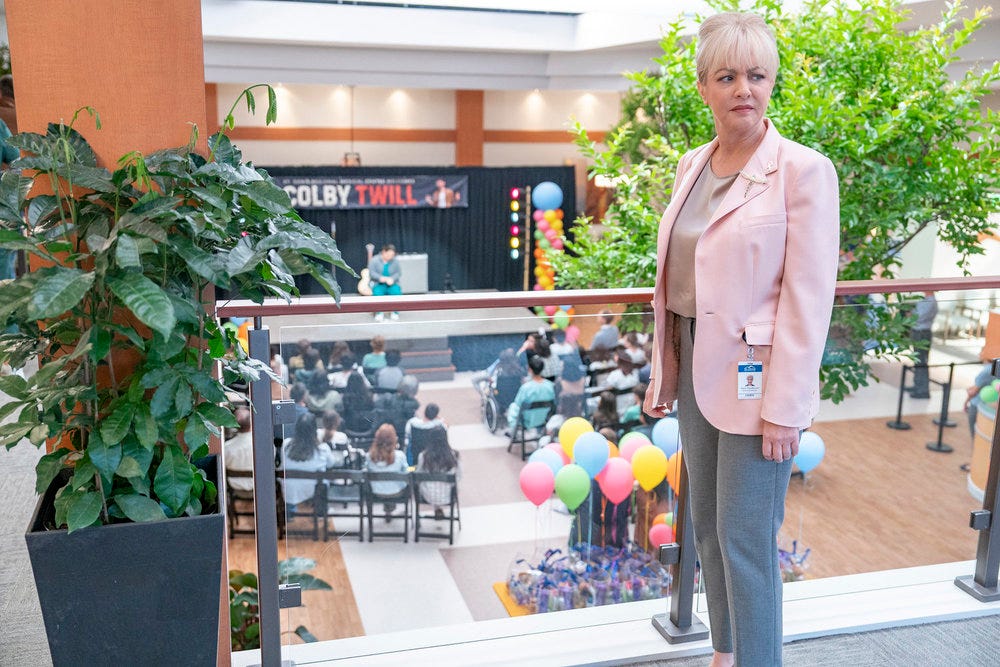
There’s also a little bit of Quantum Leap in St. Denis Medical, as it turns out. When an episode required a hospital atrium, production brokered a deal to take over part of the recently canceled drama’s set and save the cost of disposing of it, allowing LaPlante and her team a way to fast-track the creation of what they needed. “Building our atrium set was quite a feat. As a first season, half-hour comedy, we had tight timelines, limited budgets, and big dreams. Inheriting Quantum Leap’s underground bunker gave us the framework to pull it off. We fully reimagined the space and ended up with everything we wanted,” LaPlante says. Not only that, but she and her team were able to build an entire permanent facade on the Universal backlot.
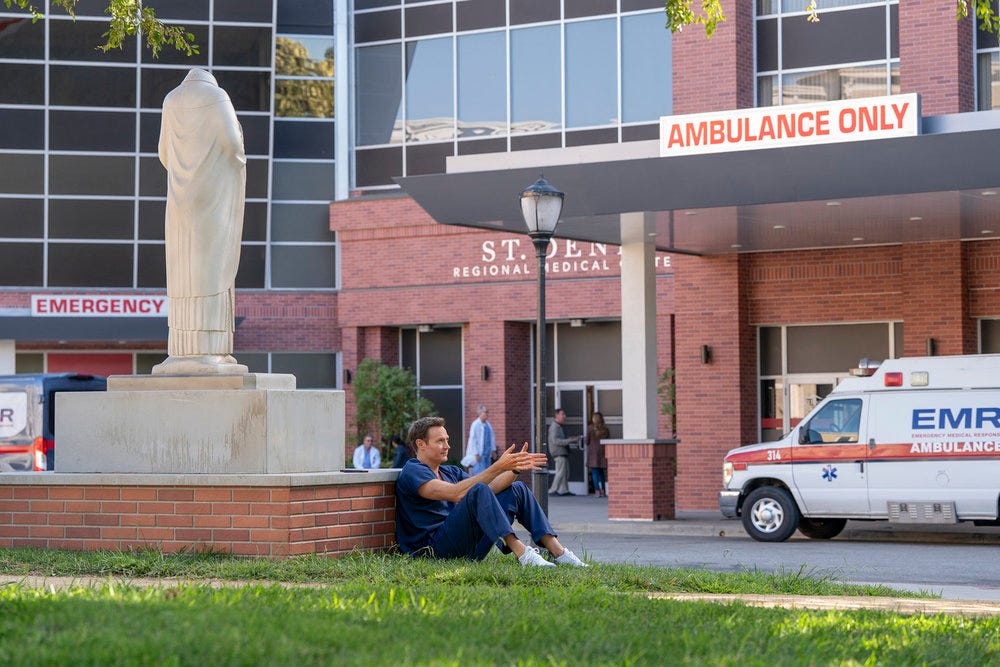
“In addition to establishing our permanent interior set for Season 1, we were also tasked with building our hospital exterior,” LaPlante says. “I worked with Universal Production and our EPs to design a facade that not only worked for our show, but also served the long-term needs of the lot. We redid an existing facade, drilled pylons to construct a cantilevered awning for our ambulance bay, and added a custom St. Denis statue to the adjacent park. I had the most amazing team around me—a phenomenal construction team, an amazing art director and set designer, a full engineering team, along with production and studio support. It was so rewarding and so fun, I loved every minute of it.”
That’s a tall order for any production designer, let alone LaPlante, who is the rare production designer to work on a network pilot and continue to series. She’s worked with series creator Justin Spitzer for over a decade, working her way from PA to art director on Superstore, and art directing American Auto before taking over as department head on Season 2.
“It felt really safe,” LaPlante says of stepping into the role from the start of St. Denis Medical. “It felt like a great place to take this next step, with this team I’ve worked with for so long. It was a huge gift. After you work with a team for so long, you start to develop a similar eye, and you get that shorthand. It felt like a great opportunity instead of something that could have been really stressful or overwhelming.”
LaPlante singles out her team for credit, too. “The people I get to work with on our show are exceptional,” she says. “They don’t often get the call outs, but the craftspeople who build these sets, paint these sets, plaster these sets…my amazing art department… I couldn’t have done it, any of it, without my amazing team.”
Not that the St. Denis Medical job didn’t come with stress, regardless. There’s the inevitable preoccupation of nailing a TV hospital’s place on the socioeconomic spectrum. “People in medical professions are trying to deliver excellent care with outdated equipment all the time,” LaPlante says. “We have two amazing med techs, and we had a lot of talks about how we balance older equipment with new technology.” There’s also creating a hospital set for a mockumentary series that works for the production.
“If you come visit our set, it is fully immersive,” LaPlante says. “You walk in and it’s shootable 360 with a full drop ceiling and the classic VCT hospital flooring. We are shooting two to three cameras at all times—we are always looking to make our set as production-friendly as possible. We move really fast. One of the things that we did in tight conjunction with our DP, Jay Hunter, was to lay out our overhead lighting grid in a way that was most complementary to our actors.”
The set allows for concentric circles of lighting to create flattering pools of light for the cast (making one wish LaPlante could swoop into every office building and do the same for the horror movie lighting in every bathroom) and then added a fill light system of magnet lights on the T bar. These are overworked medical professionals, but it’s still a TV show after all.
Although visitors to the set could be forgiven for thinking they’ve wandered into a real hospital; that’s the beauty of a 360-degree design (or the horror, if one has a phobia of hospitals). By allowing every space to be filmable at any given time, LaPlante and her team set the cast up for success by making even more room for improv. And the character touches throughout the set only enhance the performances.
“Joyce’s office has a lot of character things,” LaPlante says. “All her plants are fake. She’s not someone who wants to think about keeping her plants alive. She has a bunch of stuffed possums and critters, her little friends. Bruce proudly displays all his accomplishments on his walls, Alex has thank-you notes from patients, and our waiting room celebrates health heroes.”
And then there’s the break room. “ In our break room, we have a little framed thing of fly fish hooks,” LaPlante says. “It says something about ‘Removed from patients.’ And that is a real story from Casey Hallenbeck, my decorator. He was fishing as a little kid, and he caught himself with the hook. They had to go to the emergency room and get it taken out, and we all got to laughing because apparently that is something that happens often. And so we created a tally of our own patients.”
Elliot LaPlante’s credits include Superstore, American Auto, and Show Me What You Got. She submitted Episode 17, “Bruce-ic and the Mus-ic,” for Emmy Award consideration. Her craft services go-to? “ I love the mornings when they get us the fresh-pressed juice. And I am obsessed with the half cookie, half brownie that they make. I think it’s cookie on the bottom and brownie at top. Absolute fave.”
 Meet Me at Crafty
Leave a comment