Like its characters, costume designer Daniel Selon found himself while traveling the Witches Road of Agatha All Along. An Emmy winner for his work in the costume department on Jac Shaeffer’s WandaVision, he became department head for its spinoff, starring Kathryn Hahn as a wicked witch (according to her, the inspiration for the Wicked Witch of Oz fame) who leads a motley band of magic-wielding women and one mysterious teen through a terrifying journey.
“Agatha was truly a new turning of a chapter,” Selon says. “For me, it was a leveling up in just the scale and the size of the show that I was being given the responsibility of helming. And it was also an energetic shift for me. It was me really stepping into a new phase of being a leader, owning my age and queer experience as a person and putting it to work for a creative design.”
Meet Me at Crafty is reader-supported (for now!). So please consider becoming a paid subscriber—although free subscribers mean the world, too! As do those who forward us. We’re pretty forward ourselves.
All that experience paid off. Selon’s work is like an entire portfolio brought to character-specific life over the course of nine episodes. Looking to hire a costume designer for a procedural? Check out his work in the first episode. Need someone to conjure up the decadence of the ‘70s? He did it magnificently with Episode 4. And the next time Nicole Kidman gets an itch to play a wealthy woman with secrets in a beachside house, Selon could handily dress the cast based on Episode 2 [see the below photo for proof].
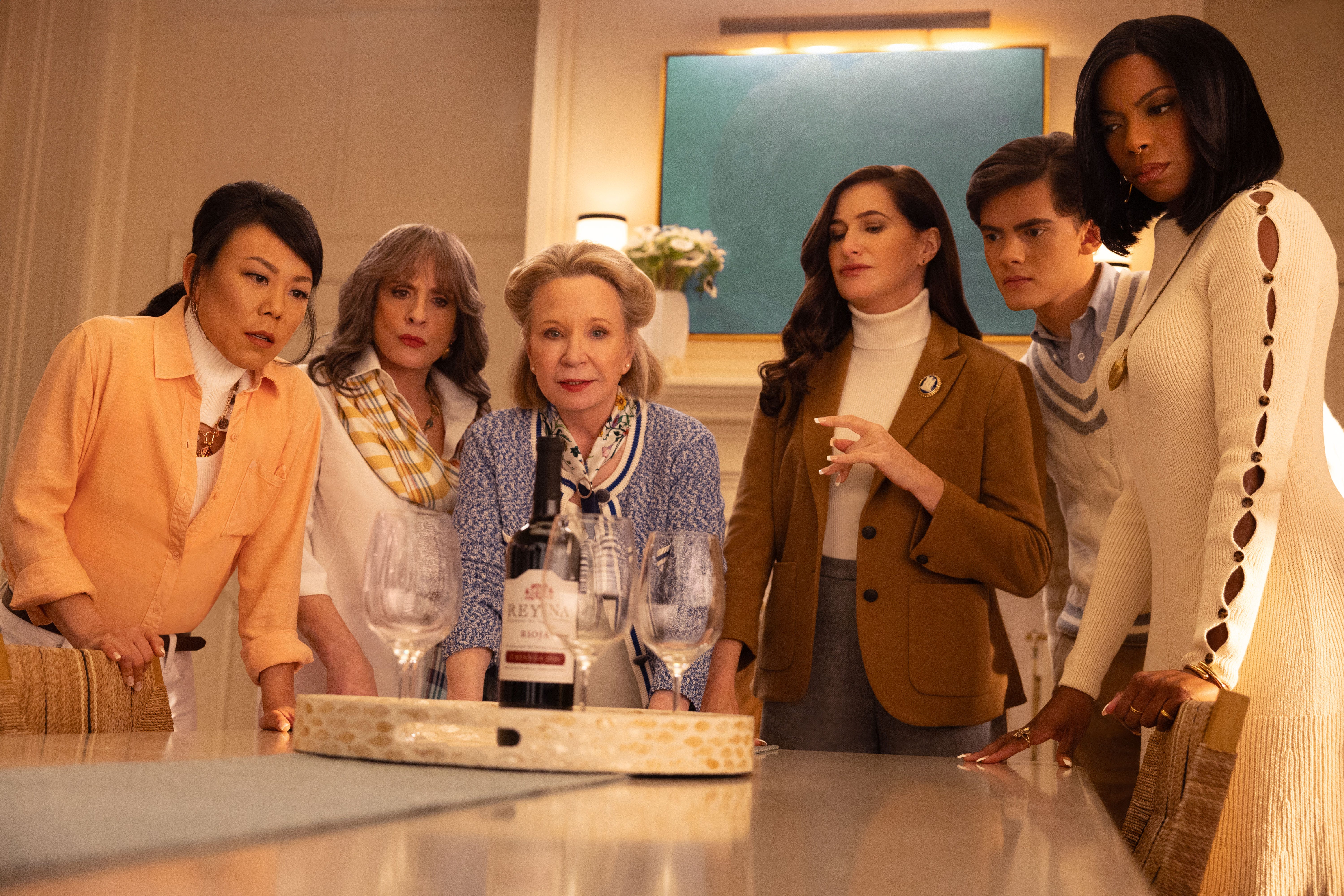
“I pinch myself. I’m just like, ‘How did this happen?’” Selon says. “It’s almost like I had 10 years of career experience and growth smashed into 11 months of production. Which is a bit in keeping with the way that my life has gone. As an artist, there’s always been these incredible leaps forward, which have only happened because someone has taken a chance on me. And it’s usually a powerful woman who sees something in me. This has been my experience as a queer man: I’ve been given access to places because I am a white man, but then you still have to follow it up with the goods. And to do that, you often need the opportunity to show the goods. And that has been often gifted to me by a woman who says, ‘Hey, come on in and let’s see what you got.’ And that was definitely the show for me.”
Selon’s journey with Agatha began in Atlanta, reading the episode outlines while working on Blue Beetle (“I read it in the bathtub,” he says. “I feel comfortable with the world knowing that”), and he had an immediate sense of what the job could mean for him. His prior experience working with Shaeffer and Hahn helped too, knowing “ that I was stepping into a creative team who had my back and wanted me to succeed as a costume designer.”
As with any Schaeffer show, Agatha All Along hides clues to its true intentions throughout its episodes, including its Easter egg-laden costumes. Not until the ultimate destination is revealed do they all assemble into a unifying whole. And even though the same legerdemain infused WandaVision, audience reaction to the first episodes of Agatha was disappointingly frustrated.
“ As creators, we have our chats and our text threads, and we’re talking as the episodes roll out,” Selon says. “And we’re watching people have those reactions, and we’re reading the threads, and we are deliciously wringing our hands saying, ‘Ohhh, they don’t get it yet.’ It’s pleasurable to watch a crowd be taken on the journey that you have laid for them.”
As many have noted, Agatha All Along is, to put it bluntly, pretty gay in terms of its tone and its content (Aubrey Plaza and Kathryn Hahn share a passionate kiss!). And some of the most iconic visuals of the series came courtesy of Selon’s designs, as the costumes take on the work of both storytelling device and the kind of giddy glam that gets recreated at the Abbey for Halloween. Think of Lilia (Patti LuPone) falling through the tower, her pink ball gown floating in midair.
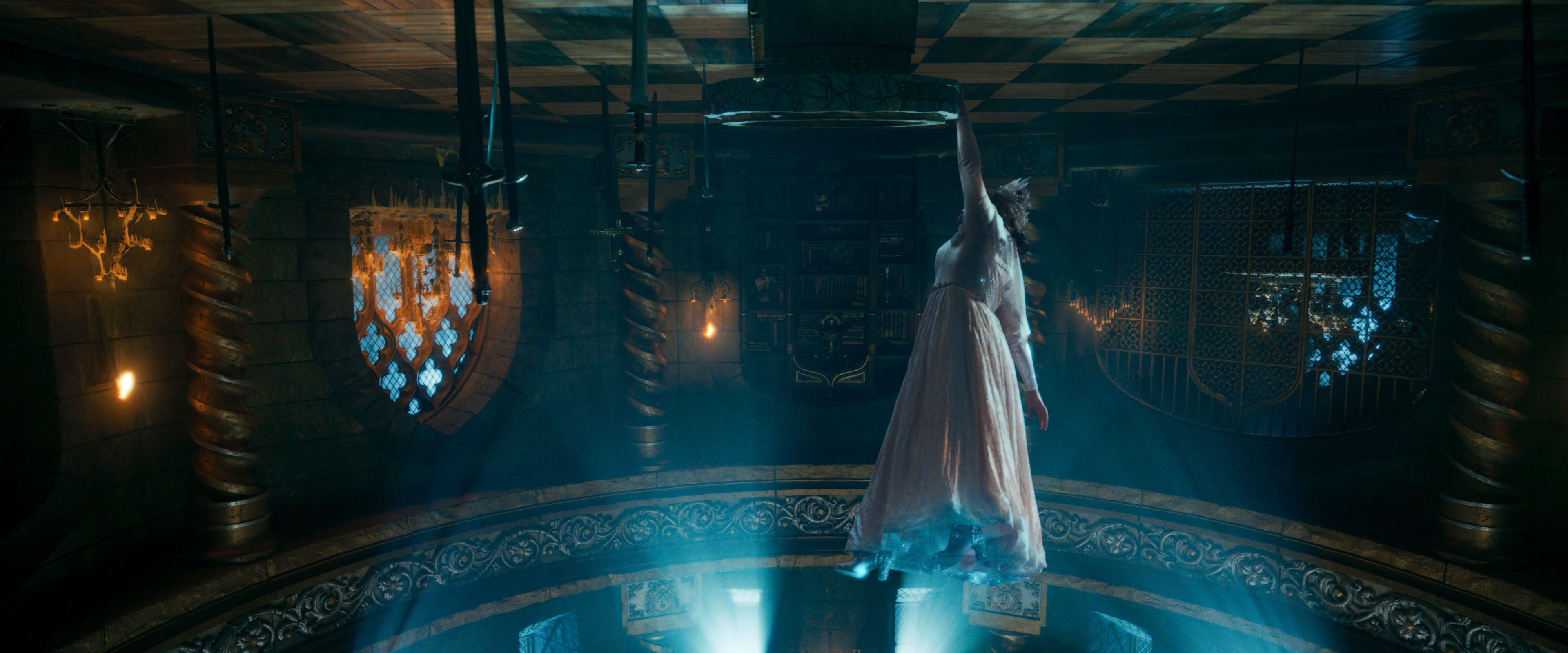
“ Costume process for me is two opposing forces,” Selon says. “It starts purely internally with character motivations and feelings and emotional states, but then at the same time I’m working from the outside in, thinking, ‘What is the composition of that key frame that we really need to see and fall in love with and never forget?’”
Specifically for Lilia’s death, Selon knew what the moment needed. “I just knew that we had to give her these voluminous skirts with all these diaphanous layers that would catch the wind, and that it would be this epic and heartbreaking fall,” he says. “And I’m thinking in silhouette, but I’m also thinking, ‘What does she need to feel like in her heart?’ So yeah, how do you kill a witch? Fabulously.”
Part of the success of the show’s costume designs stems from Selon’s openness to collaboration. That iconic fall is perhaps the defining visual of the series (at least for this gay viewer), but Selon also came up with vivid costume pieces for Hahn to play with, proving that she is as adept with acting via wardrobe as she is at delivering a zinger.
“Episode 2, where she’s wearing this shawl nine ways, that was me saying, ‘What does she wear for the getting-the-gang-together look?’ She needs to be code-switching between all these different witches, so I was like, ‘What could she grab from her house that she could wear a bunch of different ways? She’s mercurial, she needs to be able to shapeshift.”
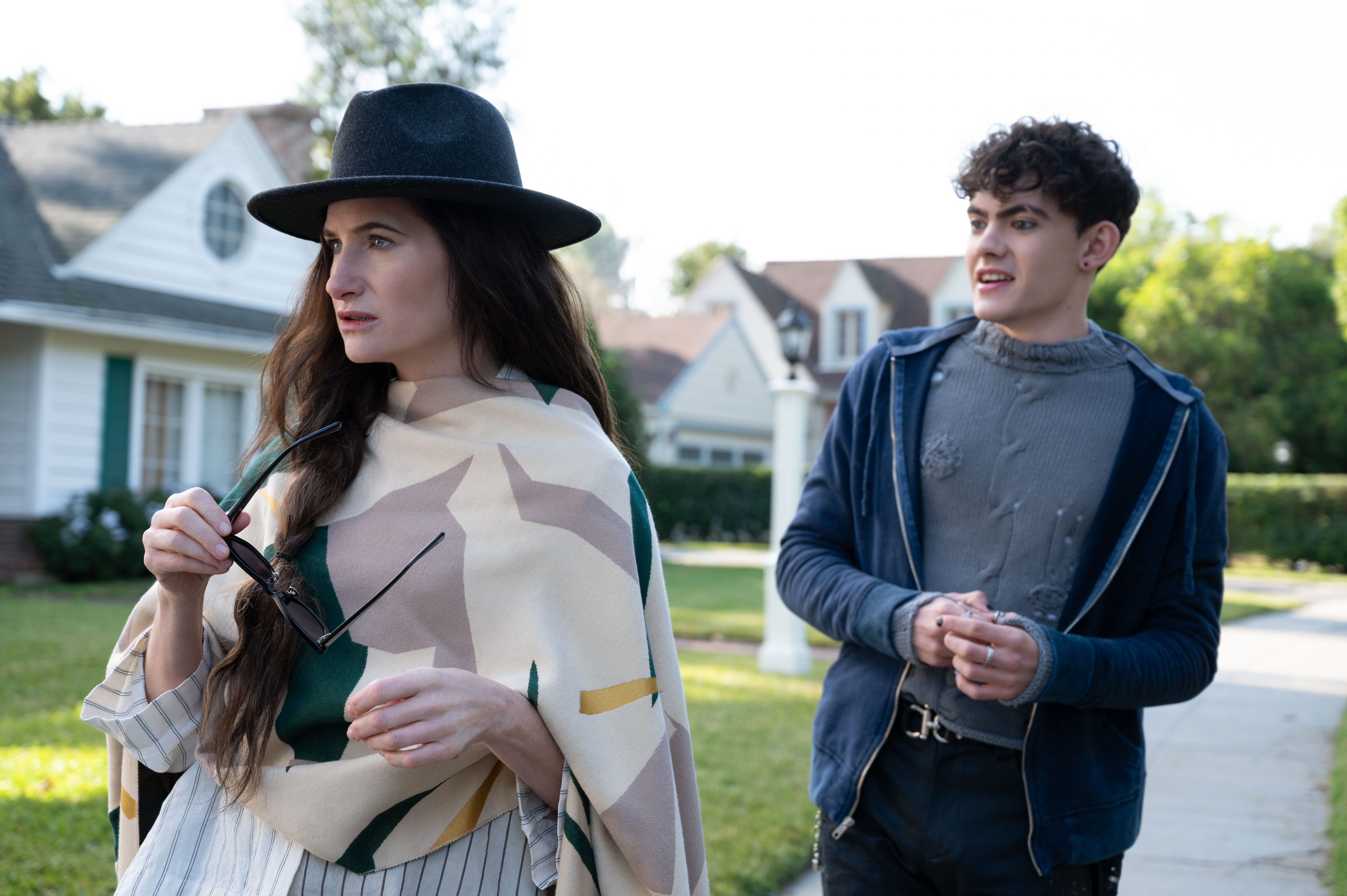
Ultimately, Selon landed on a back-of-the-couch throw that could double as an over-the-shoulder scarf, along with a crisp black fedora as foreshadowing of Agatha’s eventual pointy black hat. But topping it all off is a strand of pearls that Agatha constantly plays with, twisting them in whatever feigned emotion she’s putting on to lure witches into forming a new coven.
The pearls weren’t initially part of the costume. In fact, they were intended for Joe Locke’s Billy, part of a look they ended up jettisoning. Instead, the team hung them on his rear view mirror, where Hahn spotted them and suggested adding them to finish off her look.
That kind of collaboration is at the heart of Selon’s work, particularly with Plaza’s Rio. “Aubrey is such a good example of how the costumes shifted because of who was cast,” Selons says. “She has a singular sort of quality and tonal thing about her, and so certain things that you put on her, you immediately know if they’re right or not. It makes for a very efficient fitting because you’re putting stuff on and you’re like, ‘Nope, what’s next?’”
That extended to her Green Witch costume, which had many iterations. “Everybody had different ideas about what the Green Witch would be and how femme or masc or magic or contemporary,” Selon says. “I really love where we landed, but it took a second. There was a little bit of questioning in the 11th hour: ‘Should this costume be quite different?’ But we stuck with it, and I’m glad that we did.”
Daniel Selon is an Emmy-winning costume designer whose work on Agatha All Along scored him two CDGA nominations. His other credits include Thor: Love and Thunder, Dr. Strange in the Multiverse of Madness, The Hotwives of Las Vegas, and Going Down in La-La Land. His go-to at crafty? “It’s a little bit of a tortured process for me. I go there and I see the donuts first and I’m like, ‘Did I earn a donut today?’ And usually I talk myself out of it, so I don’t eat the donut. And then I will contemplate the cut fruit. But what I end up eating is a bag of pickles. I’m telling you, I am a garbage human. I like to watch television in the bathtub, and I choose to eat sodium from a bag.”

 Meet Me at Crafty
Leave a comment